
 Let’s Connect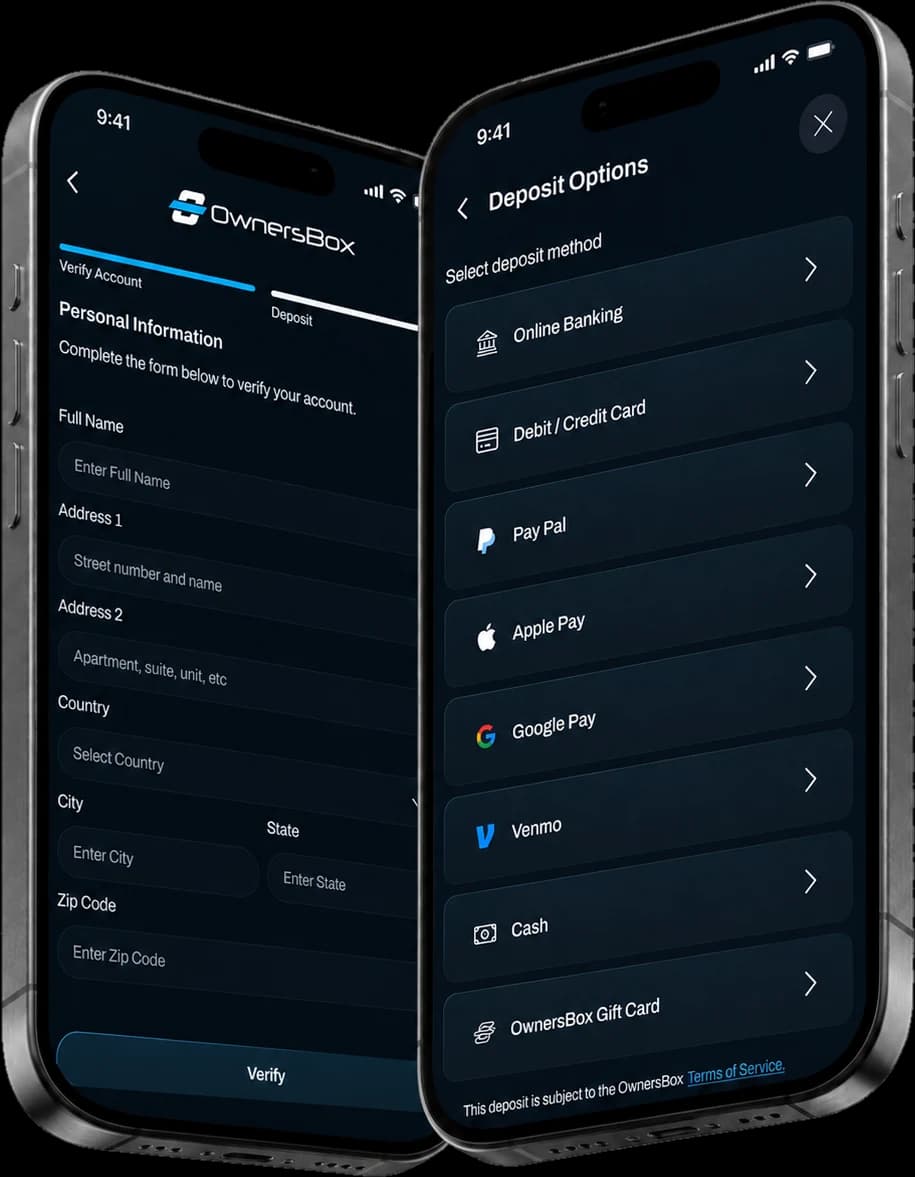
User Activation
Onboarding & Conversion
A faster path from first visit to first deposit
I rebuilt the onboarding journey for a regulated real-money fantasy sports platform, removing friction across product discovery, registration, identity verification, geolocation, promotions, payments, and account security.
At a Glance
- Challenge
- Signup and verification drop-off
- Approach
- Simplified signup, KYC, and deposit flow
- My Role
- Led analysis, design, and delivery
- Impact
- +60% conversion and 92% KYC first-attempt success
The challenge
We were asking for commitment before demonstrating value
New visitors were directed immediately into account registration. There was no signed-out experience where they could explore the platform, understand its games, or see what OwnersBox offered before being asked for personal information.
Registration then spread the required information across a long sequence of individual pages. Even after creating an account, users still faced the journey’s largest barriers at identity verification and deposit.
Identity verification was entirely manual. Users had to photograph their ID, take a selfie, send both to customer support, and wait for review. Location eligibility relied on IP lookup, which could incorrectly place eligible users outside a supported jurisdiction.
Those who completed verification then encountered limited deposit options. The cumulative friction made it unnecessarily difficult to progress from initial interest to first deposit.
The problem was not a single poorly performing screen. It was a disconnected journey with friction at every point between first visit and first deposit.
The product strategy
Redesign onboarding as one connected system
Rather than treating registration, verification, promotions, and payments as separate features, I approached them as parts of one conversion journey.
The program was guided by four principles:
- Demonstrate product value before asking users to register
- Automate the primary path wherever verification was possible
- Preserve reliable fallbacks for users who could not complete the automated path
- Remove unnecessary effort without weakening regulatory or security controls
Because each area involved different systems and dependencies, the transformation was delivered through several releases rather than one large redesign. Each release removed another barrier between product discovery and first deposit.
- Product access
- Registration
- Verification
- Promotions
- Payments
Product access
Let users explore before signing up
The original experience sent first-time visitors directly into registration. Users had to commit before they could properly understand the platform or explore its games.
I introduced a signed-out experience that allowed prospective players to browse and interact with the product before creating an account. This changed the beginning of the journey from an immediate request for personal information into an opportunity to establish interest and trust first.
Account creation
Collect the same information with less friction
The existing registration journey spread required information across too many individual pages and interactions. Although the platform still needed to collect the information required for a regulated real-money product, the experience did not need to feel as long or fragmented as it did.
I consolidated related information into fewer, more efficient steps and clarified the path through account creation. I also introduced two-factor authentication to strengthen account protection as the journey became faster and more streamlined.
The goal was not simply to minimize the number of screens. It was to make every step feel necessary, understandable, and proportionate to what the user was trying to accomplish.
Verification
Move verification from manual to real time
Identity verification previously required users to leave the onboarding flow, photograph their ID, take a selfie, send both to customer support, and wait for manual approval.
I led the integration of IDComply to bring identity verification directly into the product and provide eligible users with a real-time result. IDComply’s integrated fallback remained available when the primary verification path could not resolve a case, with manual support review retained as the final exception path.
Location eligibility had relied entirely on IP lookup, which could incorrectly block eligible users. I introduced GeoComply for pinpoint geolocation accuracy while retaining IP lookup as a fallback.
Automation became the primary experience without eliminating the exception handling required by a regulated platform.
Promotions
Apply the right offer automatically
Sign-up promotions were an important part of the acquisition journey, particularly for users arriving through affiliate campaigns.
When the platform could verify the user’s source and match it to a qualifying offer, the correct promotion was applied automatically. This reduced mistyped codes, invalid-offer issues, and the risk of users completing registration without receiving the promotion they expected.
A manual promo-code field remained available when the acquisition source could not be reliably identified.
Payments
Remove the final barrier to first deposit
After navigating registration and verification, users still had limited ways to fund their accounts. Deposits supported only credit and debit cards, while withdrawals were issued through physical cheques sent by mail.
I expanded the platform’s money-movement capabilities through PayNearMe, adding modern deposit and withdrawal methods that better matched user expectations.
This was more than a payments improvement. Deposit represented the final conversion event in the onboarding funnel. Giving users familiar and convenient ways to fund their account removed friction at the moment when intent was highest.
The result
60%increase in first-time-depositor conversion
22%35%
Registration-to-first-deposit conversion
Registration-to-first-deposit conversion increased from approximately 22% to 35%.
Because the program was delivered through multiple releases, the result should not be attributed to one isolated change. It reflected the cumulative effect of improving the full journey.